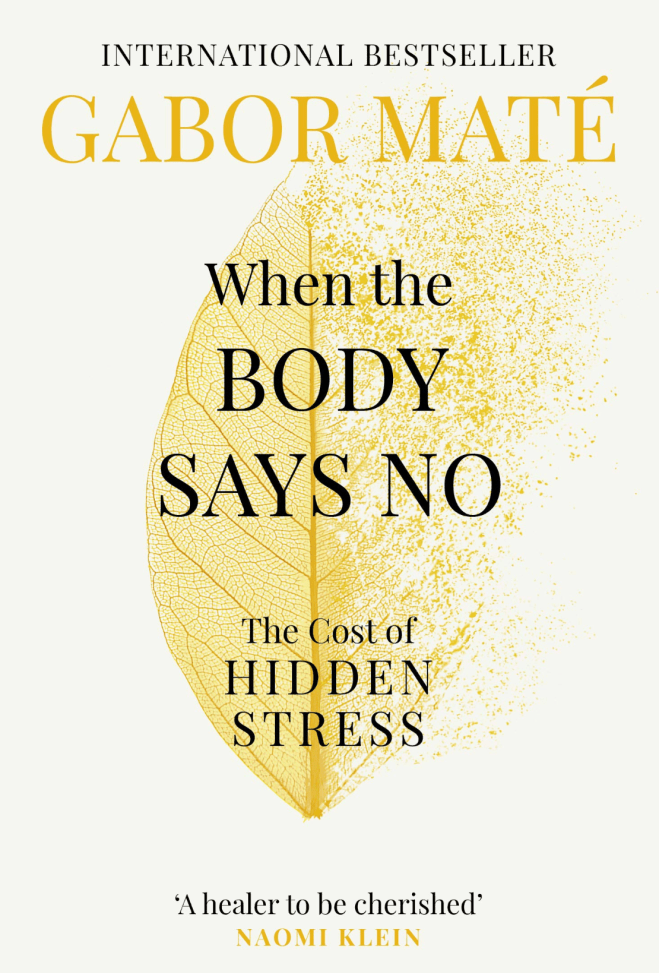
“When the Body Says No: The Cost of Hidden Stress” by Gabor Mate is a book that I purchased quite a few years ago. There are a few of those: I get them and then set them to read later and then forget completely and never get back. This year my goal is to “shop more in my closet” so I started looking through the books that are on my shelf already!
“When the Body Says No” could probably be categorized as a popular science book that focuses on hidden stress and what implications it can have globally on your whole body over the years. The author mentions that there were some findings in the research studies that connected hidden stress to the development of different types of cancer, multiple sclerosis as well as other autoimmune diseases.
I also liked the section of the book that focused on repressing emotions as a child and how it later forms our reactions to stress in our adult years. I even had quite an interesting insight into why I was reacting to something in my life in a very traumatic way for years. I tried coaching and psychology consultations but nothing really helped me to get to the bottom of it until I read this book and realized that it was my defense mechanism formed during my childhood trauma so in the least, I will be thankful to this book for that.
If I had to summarize the book in one sentence, it would be that a lot of diseases have psychological roots or at least in some part are influenced by our mental state, and having a strong emotional competence can be a powerful prevention and healing mechanism. The author defines strong emotional competence as:
- “the capacity to feel our emotions, so that we are aware when we are experiencing stress;
- the ability to express our emotions effectively and thereby assert our needs and maintain the integrity of our emotional boundaries;
- the facility to distinguish between psychological reactions that are pertinent to the present situation and those that represent residue from the past. What we want and demand from the world needs to conform to our present needs, not to unconscious unsatisfied needs from our childhood. If distinctions between present and past blur, we will perceive loss or the threat of loss where none exists; and
- the awareness of those genuine needs that do require satisfaction, rather than repressions for the sake of gaining the acceptance or approval of others.”
If any of these parts of emotional competence is neglected and not honored, the stress starts accumulating negatively affecting different parts of our body. These different parts of emotional competence can be endangered in different ways: when you are a child and you see your parents struggling, you might hide your emotions and be a “good kid” to burden them less and protect them. While the intention is good here, a child eventually accumulates stress and emotions without learning a proper way to express them which can lead to psychological and physiological trauma in the future. This is just one of the examples that the author talks about and there are many more mentioned in the book. I will add some of the thoughts that I found interesting to think about below:
***
“It was in a relationship to melanoma that the notion of a “Type C” personality was first proposed, a combination of character traits more likely to be found in those who develop cancer than in people who remain free of it. Type A individuals are seen as “angry, tense, fast, aggressive, in control” – and more prone to heart disease. Type B represents the balanced, moderate human being who can feel and express emotions without being driven and without losing himself in uncontrolled emotional outbreaks. Type C personalities have been described as “extremely cooperative, patient, passive, lacking assertiveness and accepting… The Type C individual may resemble Type B, since both may appear easygoing and pleasant, but … while the Type B easily expresses anger, fear, sadness, and other emotions, the Type C individual, in our view, suppresses or represses ‘negative’ emotions, particularly anger, while struggling to maintain a strong and happy facade.”
***
“Infants whose caregivers were too stressed, for whatever reason, to give them the necessary attunement contact will grow up with a chronic tendency to feel alone with their emotions, to have a sense – rightly or wrongly – that no one can share how they feel, that no one can “understand”. We are speaking here not of a lack of parental love, nor of physical separation between parent and child, but of a void in the child’s perception of being seen, understood, emphasized with and “got” on the emotional level. The phenomenon of physical closeness but emotional separation has been called proximate separation. Proximate separation happens when attuned contact between parent and child is lacking or is interrupted due to stress on the parent that draws away from the interaction”.
***
“The core belief in having to be strong enough, characteristic of many people who develop chronic illness is a defense. The child who perceives that her parents cannot support her emotionally had better develop an attitude of “I can handle everything myself”. Otherwise, she may feel rejected. One way not to feel rejected is never to ask for help, never to admit “weakness” – to believe that I am strong enough to withstand all my vicissitudes alone”.
***
The author also shares seven principles of healing your emotional competence:
- Acceptance: the willingness to recognize and accept how things are
- Awareness: reclaiming the lost capacity for emotional truth-recognition
- Anger: allowing yourself to experience a physiological process of anger – it does not need to be a rage or acting out
- Autonomy: the development of the internal center of control or being able to know where your boundaries are and to set these boundaries
- Connection: building genuine connections with others
- Assertion: the declaration to ourselves and to the world that we are and that we are who we are. An assertion may be very oppositive to action, not only in the narrow sense of refusing to do something we do not wish to do but letting go of the very need to act
- Affirmation: moving towards something of value
I understand that this book is a popular science book and I have written enough scientific papers to know that sometimes to support your cause, you would focus on some parts of the studies and ignore the other parts so I take this book with a grain of salt. I thought it was interesting, regardless!
 Kat's Thoughts
One Comment