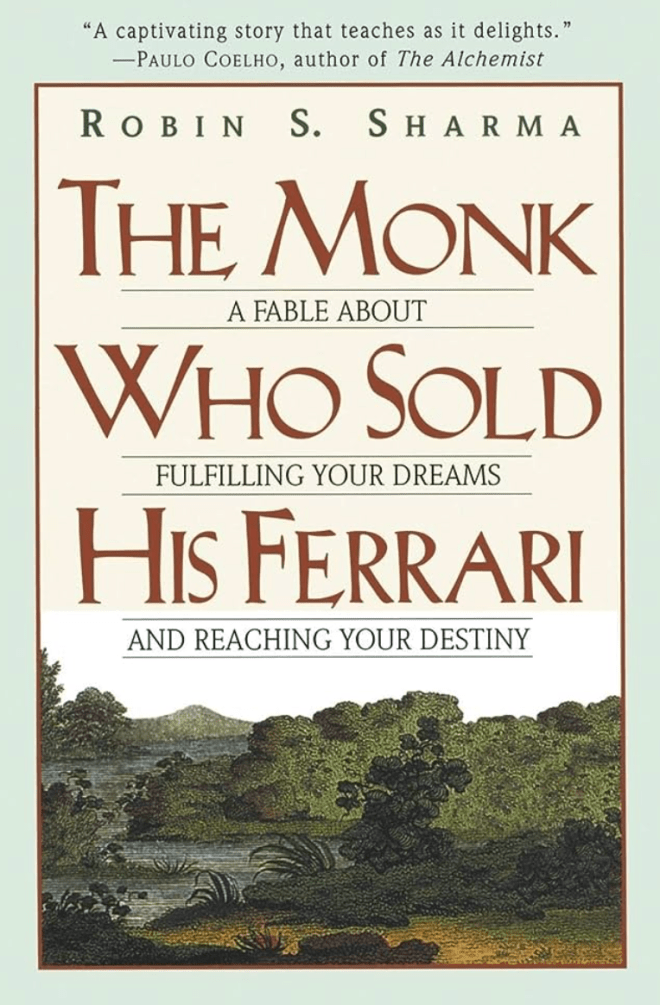
“The Monk Who Sold His Ferrari” is a self-help book by Robin Sharma. I don’t completely remember how I came across it but it seemed like a lighter read. I generally rated it with 3 starts on Goodreads mostly because I could not grapple with how it was written.
In the essence of the story, we meet a lawyer who talks about his hot-shot friend Julian who was also a lawyer, had a heart attack and went to India to search for life wisdom. He then came back as a completely new and transformed person and shared the wisdom that he learned from the Indian sage. It is that wisdom that we as readers are exposed to.
Although I found that most of the advice that Sharma was giving was solid, some of it was also questionable such as not needing more than 6 hours of sleep per day. Also, I could not handle the writing: it would often include the dialog where Julian would deliver his wisdom from sages and then the other person would response something like “Okay, cool, dude”. It just did not make the text cohesive and flowing.
Here are some notes that I highlighted on the suggestions that the author has about productivity and self-improvement. These are mostly the ones that I found interesting but I don’t necessarily agree with all of them:
- But I have learned that self-mastery and the consistent care of one’s mind, body and soul are essential to finding one’s highest self and living the life of one’s dreams. How can you care for others if you cannot even care for yourself? How can you do good if you don’t even feel good? I can’t love you if I cannot love myself”, he offered.
- “In the fable, the garden is a symbol for the mind”, said Julian. “If you care for your mind, if you nurture it and if you cultivate it just like a fertile, rich garden, it will blossom far beyond your expectations. But if you let the weeds take root, lasting peace of mind and deep inner harmony will always elude you.”
- Yet look at the toxic waste that most people put into the fertile garden of their minds every single day: the worries and anxieties, the fretting about the past, the brooding over the future and those self-created fears that wreak havoc within your inner world.
- There are no absolutes. The face of your greatest enemy might be the face of my finest friend. An event that appears to be a tragedy to one might reveal the seeds of unlimited opportunity to another.
- When you are inspired by some great purpose, some extraordinary project, all of your thoughts break their bonds: your mind transcends limitations, your consciousness expands in every direction and you find yourself in a new, great and wonderful world. Dormand forces, faculties and talents become alive and you discover yourself to be a greater person that you ever dreamed yourself to be.
- If you want to live a more peaceful, meaningful life, you must think more peaceful, meaningful thoughts.
- Find out what you truly love to do and then direct all of your energy towards doing it,
- You must spend some time every day, even if it is just a few minutes, in the practice of creative envisioning.
- He who serves the most, reaps the most, emotionally, physically, mentally and spiritually. This is the way to inner peace and outer fulfillment.
- The purpose of life is a life of purpose. Those who are truly enlightened know what they want out of life, emotionally, materially, physically and spiritually.
- Lasting happiness comes from steadily working to accomplish your goals and advancing confidently in the direction of your life’s purpose.
- The happiness you are searching for comes through reflecting on the worthy aims you are dedicated to achieving and then taking action daily to advance them.
- You will never be able to hit a target that you cannot see. People spend their whole lives dreaming of becoming happier, living with more vitality and having an abundance of passion. Yet they do not see the importance of taking even ten minutes a month to write out their goals and to think deeply about the meaning of their lives.
- People generally achieve magnificent things when their backs are up against the wall and they are forced to tap into the wellspring of human potential that lies within them.
- They truly believed that a day without laughter or a day without love was a day without life.
- We do not do things because we love to do them. We do things because we feel we have to do them. This is a formula for misery.
- Taking time to master your mind, to care for the body and to nourish your soul will put you in a position to develop more richness and vitality in your life.
- The only limits on your life are those that you set yourself. When you dare to get out of your circle of comfort and explore the unknown, you start to liberate your true human potential.
- When fear rears its ugly head, neat it down quickly. The best way to do that is to do the thing you fear.
- Truly enlightened people, those who experience deep happiness daily, are prepared to put off short-term pleasure for the sake of long-term fulfillment.
- Solitude and quiet connect you to your creative source and release limitless intelligence.
- When you control your thoughts, you control your mind. When you control your mind, your control your life.
- Those who have never been exposed to the principle that time master is life mastery will never realize their enormous human potential.
- Act as if failure is impossible and your success will be assured. Wipe out every thought of not achieving your objectives, whether they are material or spiritual.
- Stop spending so much time chasing life’s big pleasures while you neglect the little ones.
- Life doesn’t always give you what you ask for, but it always gives you what you need.
- For what lies behind you and what lies in front of you matters little when compared to what lies within you.
Generally, it is not a bad book but I definitely recommend taking it with a grain of salt.
 Kat's Thoughts
One Comment